Does Your Singapore Business Need a Mobile App or Just a Better Website?
Help your Singapore SME choose between mobile apps and websites. Understand costs, benefits, and government grants to make the right digital investment decision.
Adaptels
Published 28 May 2026
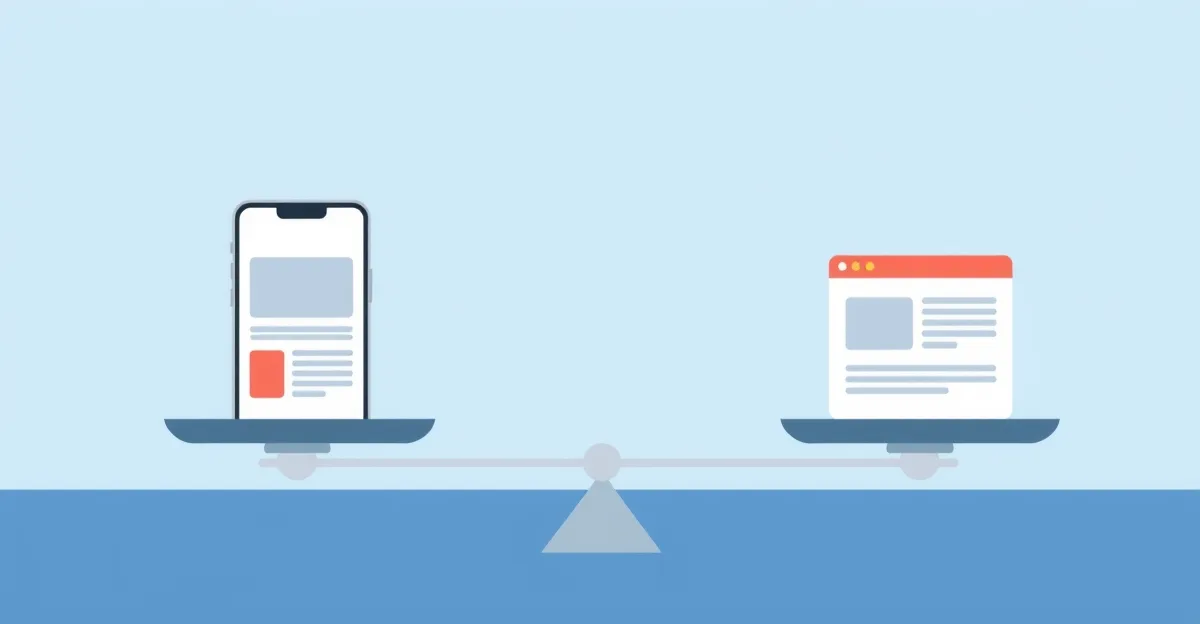
A gym owner in Tampines came to us wanting a mobile app. Push notifications for class schedules, membership management, workout tracking — the whole thing. We quoted SGD 35,000. Then we asked how many active members they had. Eighty. For 80 members, we built a mobile-responsive website with a booking system for SGD 6,000 instead. It does 95% of what the app would have done.
TL;DR: Help your Singapore SME choose between mobile apps and websites. Understand costs, benefits, and government grants to make the right digital investment decision.
This question comes up in almost every initial conversation with SME clients. The answer is usually "website first" — but not always. Here's how to think through it.
The Cost Difference Is Real
Website Development in Singapore:
- Professional custom website: SGD 3,000-12,000
- Timeline: 4-8 weeks
- Maintenance: Minimal to moderate
- Hosting and domain: SGD 50-200/month
Mobile App Development:
- Native iOS or Android app: SGD 15,000-50,000+
- Timeline: 8-16 weeks minimum
- Maintenance: Higher (OS updates, device compatibility, app store compliance)
- Ongoing developer support costs
A website typically costs a third to a fifth of a native app. And it reaches more people — websites account for about 60% of digital traffic in Singapore.
What Your Customers Actually Need
Here's the harder truth: most small to medium businesses don't need a mobile app.
Websites handle 80% of SME use cases:
- E-commerce and online sales
- Service booking and inquiries
- Customer information
- Content and portfolio display
- Lead generation
Apps make sense when:
- You need offline functionality
- Push notifications are genuinely valuable (not just nice-to-have)
- Your app is a core part of the product (delivery tracking, live features)
- You have loyal, repeat users who engage daily or weekly
- You're in gaming, fitness, or highly interactive experiences
A logistics company with driver tracking? App makes sense. A local F&B business? A responsive website with online ordering solves the problem faster and cheaper.
Government Support
The Singapore government funds digital transformation for SMEs:
PSG: Covers up to 70% for websites (capped around SGD 7,000) and apps (capped around SGD 10,000).
EDG: Up to 70% subsidy for larger digital transformation projects (capped at SGD 300,000).
IMDA Digital Acceleration: Helps SMEs accelerate growth through digital channels.
These grants remove the cost barrier. Before committing your own capital, check eligibility. PSG makes a solid website very accessible.
What Actually Works: The Phased Approach
Phase 1: Build a responsive website first
- Reaches all devices
- SEO-friendly — essential for organic discovery
- Faster to launch
- Use the PSG subsidy
Phase 2: Optimize specifically for mobile
- Progressive web apps (PWAs) bridge the gap
- App-like experience without development cost
- Works on Android and iOS
- Can work offline with proper setup
Phase 3: Consider native app only if data supports it
- After 6-12 months, review user behaviour
- Does your audience engage frequently enough to warrant an app?
- Does a native app solve a problem your website genuinely can't?
This lets you test the market, understand real demand, and spend money on what works.
When You Should NOT Build an App
- You're chasing the status symbol of "having an app"
- Your customer acquisition cost is already high (an app won't fix this)
- You have fewer than 1,000 active monthly users
- Your main need is customer information display
- You can't commit budget to ongoing maintenance
A poorly maintained app damages your brand. A website you can update in-house is almost always better than an abandoned app.
When an App Really Is the Right Call
- Real-time updates are essential (delivery, ride-hailing, live support)
- Push notifications drive genuine business value (appointment reminders, flash sales)
- Your users are highly engaged (daily or weekly repeat visitors)
- Your vertical expects apps (fitness, banking, travel)
- You have budget and team to maintain it
If two or more of these describe your business, explore an app.
Decision Framework
What problem are you solving?
- Information sharing → Website
- Real-time updates → App
- E-commerce → Website with mobile optimization
- Community → Both (website now, app later)
Who is your customer?
- Small, local base → Website is enough
- Nationwide/regional → Website first, then consider app
- Tech-forward audience → App might engage them better
What's your timeline?
- Need to launch in 6 weeks → Website
- Can wait 3-4 months → App is feasible
What's your budget?
- Under SGD 10,000 → Website, subsidized by PSG
- SGD 20,000-30,000 → Website plus PWA
- SGD 40,000+ → Explore native app alongside website
Can you maintain it?
- Someone on team to update content?
- Budget for bug fixes and security patches?
- Afford ongoing vendor support if needed?
What We Build Most Often
When clients come to Adaptels, the most common winning formula is:
- Well-designed, mobile-responsive website (the foundation)
- Strong SEO and local search optimization (reaching customers who are searching)
- Simple CMS (so you can update without technical help)
- Optional PWA layer (app-like feel, no app store gatekeeping)
This delivers 90% of the benefits at 40% of the cost. And you can add a native app later if the data justifies it.
The Bottom Line
For most Singapore SMEs: invest in a great website first.
Faster, cheaper, reaches more people. If your customers are phone-first, make that website mobile-perfect. That often solves the problem entirely.
Apps are powerful, but they're tools for specific problems. Build toward an app if your business clearly needs one — not because it sounds advanced.
Use PSG or EDG to fund it. Test with a website. Measure actual user behaviour. Then decide.
Your customers don't care whether they use an app or a website. They care whether you solve their problem quickly and reliably. Choose the solution that does that most efficiently.
Sources
Looking for more? Check out ComplyHQ.
Need help with your project?
Adaptels builds custom web applications and WordPress sites for Singapore SMEs. Let's discuss how we can help your business grow.
Get in Touch →Related Articles
Starting an E-Commerce Business in Singapore: Complete SME Guide (2026)
Launch your e-commerce business in Singapore with our practical guide. Learn regulations, funding options, platform selection, and digital strategies for SME success.
digital-strategyCustom Software vs SaaS for Singapore SMEs: When to Build vs Buy
Discover whether custom software or SaaS is right for your Singapore SME. Compare costs, benefits, and timelines to make an informed digital investment decision.
sme-technologyChatGPT for Singapore Businesses: Practical Use Cases and Getting Started
A practical guide to ChatGPT for Singapore businesses — real SME use cases, realistic SGD costs, PSG grant tips and how to get started safely and productively.